
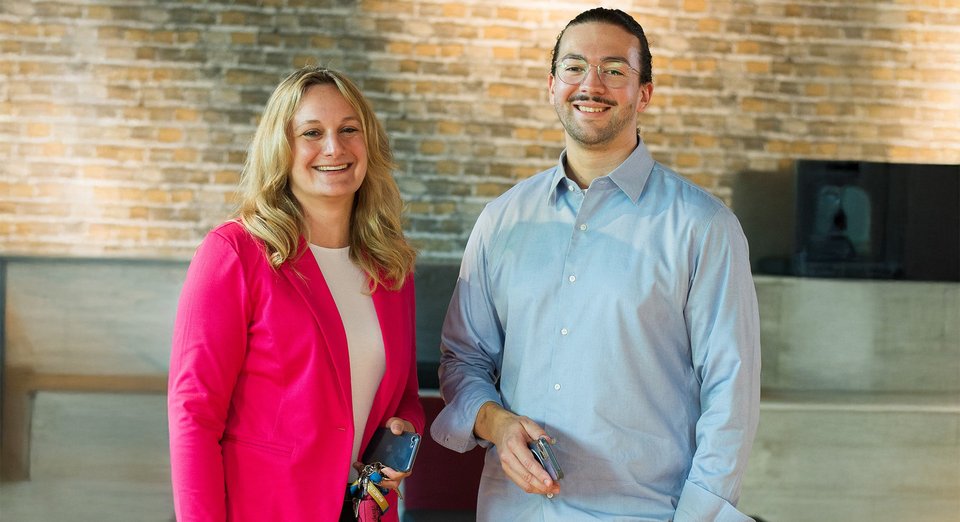
With the tools she gained from her participation in Lead up, Sarah Mevißen was able to improve the exchange within her own team and with neighbouring teams. A conversation with her and her colleague Patrick Thomas about why critical feedback is better than positive feedback - and can be easier when you're on the move.
one: Sarah, Patrick - Nice of you to take the time. Can you briefly introduce yourselves?
Sarah Mevißen: I've been Senior Buyer Own Brands in the Beverages division for around one and a half years now. I've had management responsibility for around ten years in total.
Patrick Thomas: I came to REWE via an internship and have been working as a purchasing assistant in Sarah's team since 2022.  Sarah Mevißen
one: How big is your team?
Sarah Mevißen
one: How big is your team?
Sarah: Our team consists of two buyers, three purchasing assistants and one working student - so six people in total. I manage the team in disciplinary and technical terms. However, we work closely with Category Management, Quality Assurance and other interfaces.
one: What were your expectations when you started the Lead up programme, Sarah?
Sarah: I thought it was great that REWE is offering a development programme for senior managers with Lead up. It shows that people are at the centre of everything we do. Many mandatory training programmes at REWE revolve around processes - but leadership and dealing with each other have not been a mandatory topic for experienced senior managers until now. Lead up shows that this has changed and that a cultural shift is perceptible: when it comes to leadership, people now take priority. Above all, I hoped that the programme would lead to interdisciplinary exchange - and it did, with senior managers from very different areas and age groups.
one: What did you take away from the programme?
Sarah: The programme is based on three central, so-called behaviours: Courage for new things, strengthening strengths and feedback. These topics were not new to me. I regularly take time to think about strategy and development - also with regard to teamwork. After all, good leadership requires time and attention. Studies show: People don't leave the company, they leave their manager. That's why respectful behaviour is so important.
 Patrick Thomas
one: Patrick, did you notice any changes in Sarah's management style after she took part in Lead up?
Patrick Thomas
one: Patrick, did you notice any changes in Sarah's management style after she took part in Lead up?
Patrick: There were no abrupt changes - rather a gentle breeze that has harmoniously integrated itself into our everyday life. Much of the programme was already part of Sarah's leadership style beforehand. For me, authenticity is crucial - and Sarah brings that to the table.
one: "Gentle wind" is a beautiful image. Can you explain this form of quiet change in concrete terms?
Patrick: We are a well-rehearsed team with good dynamics. Feedback has always been possible, but since the workshop we've been giving each other more frequent and targeted feedback - even unsolicited. That wasn't the case before.
Sarah: Authenticity is very important to me, and that includes leading according to the situation. You lead differently in crises than in calm times. For example, I tried out the "walking speed feedback" exchange format with my team - we go for an hour's walk together with the aim of exchanging ideas. It was unusual at first, but was quickly received very positively.
Patrick: It was a bit stiff at first, but over time it became more natural. The walk helps because you walk next to each other and move around - that makes the conversation more relaxed.
one: Talking to each other while walking sounds exciting..
Sarah:... certainly not every topic is suitable for walking, but I have learnt that negative feedback is often more helpful than positive feedback. It helps us to develop further. It's important to be aware of your own impact.
one: How do you deal with critical feedback?
Patrick: Criticism always feels personal - you think you're doing a good job. But with a little distance, you can think about it: What do I accept, what not? It's about seeing feedback as an opportunity. Of course, this doesn't apply to sensitive topics. Then I have to respond to feedback. But if I'm confronted with the fact that I often say "er", I can change that. But I don't have to.
Sarah: And it's important for me to emphasise: Feedback doesn't just have to come from senior managers. Colleagues, especially if they've known each other for a long time, often see more nuances. It's important to find the right framework - whether in a one-on-one meeting or in a team.


