
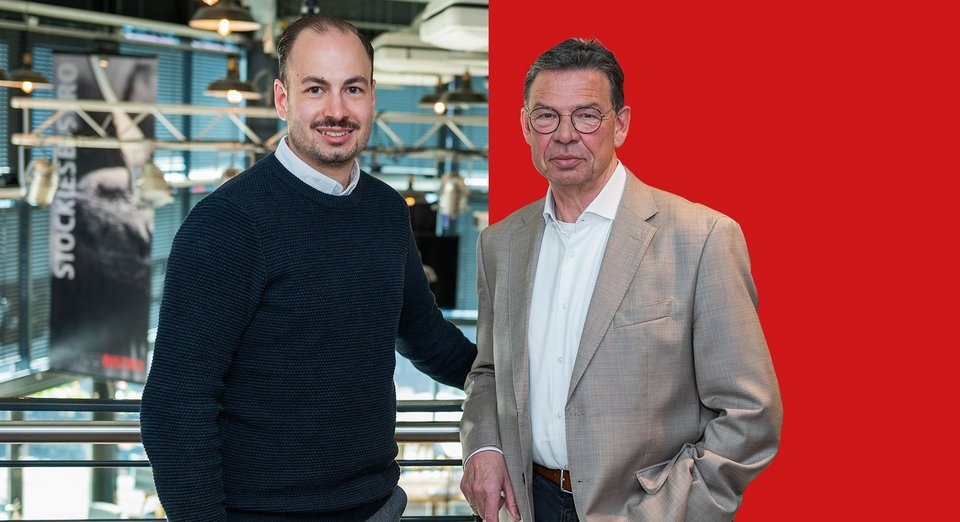
Taking on responsibility early on, thinking entrepreneurially and implementing your own ideas - the dual study programme in self-employment at REWE offers ambitious junior staff a unique perspective. Leon Lindemann, one of the first graduates, and REWE businessman Erich Stockhausen report on their experiences with a study model that combines theory and practice in a special way.
With a new variant of the dual study programme, REWE offers young people a targeted path to self-employment. Leon Lindemann is one of the first graduates. Together with Erich Stockhausen, one of the fathers of the course, he talks about early responsibility, challenging maths exams and great times in the store.
one: Mr Stockhausen, as you know, there are various paths that lead to self-employment as a REWE salesperson. Why do you need the dual study programme for self-employment? What distinguishes it from the other routes?
Erich Stockhausen: You have to differentiate. In principle, the ideal path today would be to do the Abitur, then go on the Abitur programme and then switch to the dual study programme. The question was: How do I get young people who are interested in the programme on board? Experience has shown that people who complete their A-levels at 18 or 19 will generally only become self-employed ten years later. The dual study programme opens up prospects for this period by preparing them for self-employment in theory and practice. It is important that it is attractive and that the training was not in vain, even if the student later decides to pursue a different career, for example in the head office. Both options would make sense for REWE. I am convinced that we have a great programme that is still underperforming.

„Other sectors are losing entrepreneurs, but REWE is losing more every year.“ Erich Stockhausen

one: Self-employed REWE salesperson is probably not at the top of the list for most graduates and school leavers. What speaks in favour of such a career entry?
Erich Stockhausen: You have to enjoy being self-employed and having the freedom to make your own decisions and be independent to a certain extent. The leap into the next generation, which is also the co-operative's mission, has gone well for us. Today, self-employment is also attractive to young people. This can be seen simply by the high number of second-generation members who are developing and continuing their parents' business. Sales areas are getting bigger and bigger. As a result, the demands on operators are constantly increasing. The models we develop must be so attractive that our retailers can recommend self-employment to their children with a clear conscience. Other sectors are losing entrepreneurs, at REWE there are more and more every year.
one: What relevance does the cooperative structure have for the dual study programme and what opportunities does it offer students and graduates?
Erich Stockhausen : What characterises a cooperative is the system benefit. You are a member of a cooperative in order to participate in the organisation. We help people get on their feet. With the expertise and the help, I can set up my own business. The co-operative has my back so that I can take care of my business. REWE has a good image today, people want to work for us. Sustainability, job & family - these are all real issues that many people identify with. The more good people we attract, the better we will be able to compete. At the end of the day, the human factor is crucial.
„The more good people we attract, the better we will be able to compete. At the end of the day, the human factor is crucial.“ Erich Stockhausen
one: Who would you recommend the programme to? What should applicants bring with them?
Erich Stockhausen: Above all, it should be fun, and I tell my children the same thing. You should enjoy working independently, show commitment and be willing to develop yourself. You have to know that: When you start your own business, the end is open. Maybe you'll open a second store in a few years, or you'll bring your expertise to the committees and make a contribution to the cooperative. Everyone can be happy in their own way. This flexibility is a huge advantage.
one: How does REWE's dual study programme help to encourage students to become independent and teach them important entrepreneurial skills?it used to be: apprentice, then department manager, then maybe store manager. Today: dual study programme and the prospect of becoming a senior manager! Is this still REWE - or already Rewevolution?
Erich Stockhausen: Through the selection process, we get applicants who are qualified to manage a store. The combination of studying and practical training in the shop is very good preparation for self-employment.
one: So the dual study programme for self-employment has already proved its worth, or do you still see a need for further development?
Erich Stockhausen: There is certainly always room for improvement in the details. But overall, I think the balance between theory and practice is balanced and sensible. We are seeing good development in the network. The requirements profile for the organisation is formulated in the market, which is the opposite of the top-down principle. This link to practice is fundamentally important.
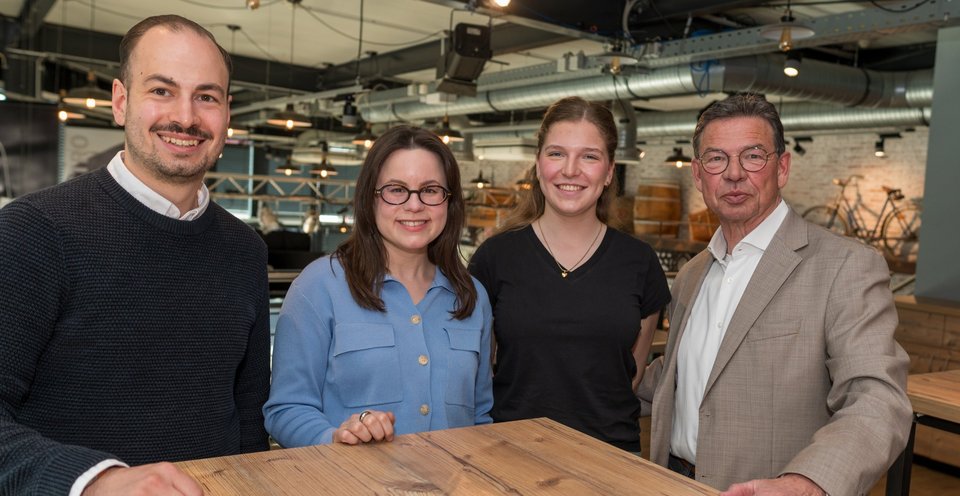
one: Leon, how did you find out about the degree programme?
Leon Lindemann : I had started doing the Abitur programme at REWE Stockhausen. I then went to the REWE Academy, level 1, after which I took the initiative myself and approached Erich. Somehow the REWE Academy is a little bubble in itself. You learn for yourself, you don't think outside the box. We sat down together and had discussions. And that's how we initiated the topic in 2020 and everything took its course.
one: Is there such a thing as a mentor? Someone who accompanied you?
Leon Lindemann : My great role model is Erich Stockhausen as an independent businessman. But there was also a lot of support all around me, for example from the store manager.
„In the market, it was nice to be able to apply what I had learnt in theory in practice. The combination made all the difference.“ Leon Lindemann
one: What did you enjoy most during your time with the Stockhausen family?
Leon Lindemann : Getting out and getting to know something new. The face-to-face meetings at Schloss Montabaur are something completely different. The network of contacts you can make there - even beyond REWE - is valuable. When else do you have the opportunity to exchange ideas with like-minded people from Munich or Berlin? The cross-divisional dialogue with the administrative departments and the sales team was also great. In the store, it was nice to be able to apply what you had learnt in theory in practice and to be able to perform in a completely different way over time. The combination made all the difference.
one: Did these experiences live up to your expectations?
Leon Lindemann: In the market, it was just as I had imagined. I had my time for university, during which I was able to take myself out of the market and didn't lose my area of responsibility in the meantime. I took responsibility for my actions. I remained a fully-fledged employee with responsibility, for example for department management. I was able to contribute ideas and implement them in projects after consultation with the store management. I was given responsibility early on. As far as the actual degree programme is concerned, I went in without any great expectations and was pleasantly surprised. All my expectations were ultimately exceeded, by the lecturers, the knowledge imparted, the network and the atmosphere at the castle.
one: What were the biggest challenges for you? In theory or practice?
Leon Lindemann: For me personally, it was time management. These are things that you learn. It was made easier by the daily routine in the store and the fixed schedule: three days working in the store, followed by two days of theory. It's important to liaise with the store manager in order to remain flexible, for example if you need more time at home shortly before handing in your homework.
one: What are you currently doing?
Leon Lindemann: After graduating, I decided to get to know the other side as well. A lot of topics came up during my studies that I wanted to get to know the practical side behind them. I'm currently in Purchasing/CM at PENNY. It's a completely different structure and culture in a discount store with smaller teams. It's interesting to get to know these processes, but of course I haven't written off self-employment. I see it as an extension at the moment.
one: Where do you see yourself in 10 years' time?
Leon Lindemann: I have two options: One is self-employment, of course. The other would be to develop my career in international procurement, because the subject is also very varied and interesting. That's really without judgement, I'm completely open to both and simply curious to see how it develops.
one: What advice would you give to people who are thinking about taking up the dual study programme in self-employment?
Leon Lindemann : Many people ask themselves whether they can manage it in terms of time - alongside work - and school grades. My most important piece of advice: just start if you have a passion for the field! There are subjects that you have to bite your way through. But the lecturers are great and you can learn a lot from practice for theory. Just get going and do it! If you're interested, the rest will come naturally.
„That is actually the great thing about the cooperative: the security, the long-term nature and the good cooperation among and with retailers.“ Leon Lindemann
one: What role does the cooperative model play in your dual study programme, and how has it supported you in your academic and practical training?
Leon Lindemann: Without the cooperative, this degree programme wouldn't even exist because it's a lengthy apprenticeship before you can go into self-employment. You need a long-term perspective and security. New markets are added every year. I think that's actually the great thing about the cooperative: the security, the long-term perspective and the good cooperation among and with the retailers.
one: Does the dual study programme at REWE help you to develop skills for independence and entrepreneurial thinking?
Leon Lindemann: Through the apprenticeship and everyday life in general, you already have the know-how on the shop floor. The degree programme gives you the methodology and tools to question a lot of things self-critically. The great thing was the combination of theory and practice. What you do with the tools you are given is up to you. But you have the opportunity to look at and evaluate the whole thing from the outside, to scrutinise and initiate projects. The cross-industry network that you build up during your studies, both within and outside REWE, is also very valuable and unique.
one: What do you find particularly appealing about self-employment - compared to the security of a permanent position with fixed holidays and regular working hours?
Leon Lindemann: The biggest motivation is to show future generations that retail is a very exciting working environment. I somehow slipped into it back then. I started as a temp. The longer I was there, the more I learnt to appreciate the environment. Retail is super exciting, innovative and a lot is developing. You can take on a mentoring role as a retailer in the future. Building that up yourself is the biggest motivation.
one: What do you think is the greatest charm of self-employment overall?
Leon Lindemann: Definitely the personal responsibility. Realising projects and adapting them to regional conditions. The fact that you have the freedom to develop and organise yourself and can add value.
one: When you talk to people of the same age who are not completely unfamiliar with the industry, what were their reactions to your choice of degree programme?
Leon Lindemann: The fact that I had already worked in retail before and had my sights set on self-employment early on meant that there was no great surprise. It's different when you study full-time, it's a different life again. But my friends who are doing a dual study programme at other companies have seen the advantages at REWE. They had no time off and had to work on the material at weekends or in the evenings. REWE and the store are fully behind you, so you can give your all during your studies, but at the same time you don't lose touch with the field.
one: Where was the toughest reality check? In the lecture theatre or when checking the best-before date in the chiller cabinet?
Leon Lindemann: The worst was the first maths lecture. But then that too passed. There are always challenges in everyday market life. It was difficult for me when a cashier was absent.
 Leon Lindemann
Leon Lindemann
Leon Lindemann
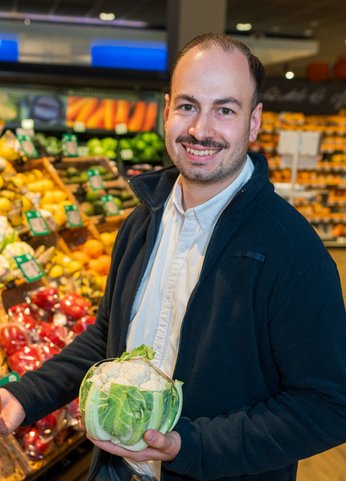
Leon Lindemann, 27, completed the dual study programme after his A-levels with the aim of becoming self-employed. He is currently gaining further valuable experience at the head office in order to consolidate his foundation of theoretical knowledge and possibly complete his Master's degree.
 Erich Stockhausen
Erich Stockhausen
Erich Stockhausen
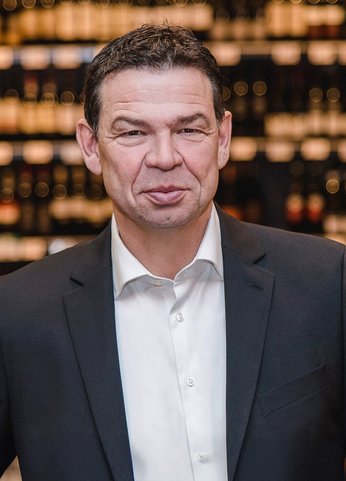
Erich Stockhausen manages two REWE stores in Erkrath with 140 employees. The long-standing Chairman of the Supervisory Board of the REWE Group found his way into retail via a diversion of studying agricultural science, which he learnt from the bottom up with an apprenticeship at Spar. With no store manager experience, he jumped into the deep end of the independent food retail sector at the age of 28. "It was a bit exhausting, but it worked," he says looking back.
The three-year Bachelor's degree programme is a combination of modern business administration and specialist and industry-specific know-how. In the first four semesters, students learn the basics of business administration. In the fifth and sixth semesters, students then specialise in retail. Students acquire their theoretical knowledge at the ADG Business School in Montabaur, where they spend eight days per semester, and in self-study e-learning units. At the same time, they go through all market areas and gradually take on more responsibility. The programme trains them for self-employment with REWE and nahkauf.
adg-business-school.de
rewe.de/self-employed
studium- selbstaendigkeit@rewe-group.com


