
Artificial intelligence has now become an integral part of our everyday working lives and is also shaping our understanding of reality. The good news is that each and every one of us can play a part in making AI use more inclusive. Our transformation expert, Natalia Schwarz, offers tips on how staff can use AI in a more conscious and inclusive way.
Numerous studies show that AI can reinforce existing social inequalities. This is because AI calculates probabilities based on training data that depict the world as it used to be. This is precisely where the problem lies, explains Natalia Schwarz from REWE Group's AI Hub, where she is responsible for AI change management, among other things. Because if senior managers have historically been predominantly male, white and middle-aged, AI depicts exactly this image. If carers were usually portrayed as female, AI continues this pattern. If people with visible disabilities hardly appear in the data, the AI hides them in the results. The term "bias" describes precisely this distortion. AI bias arises from data, the developers' perspectives and user behaviour.
Our Bias Gallery juxtaposes AI-generated images of different occupational groups with real portraits from the REWE Group. This contrast highlights the gap between algorithmic expectations and our diverse reality. It is particularly striking that the people depicted show hardly any individual or distinctive features. Instead, they predominantly conform to a uniform, ‘conventionally attractive’ appearance. Furthermore, there are errors in the depiction of workwear and logos. The aim of the gallery is to raise awareness amongst staff about the critical and responsible use of AI.
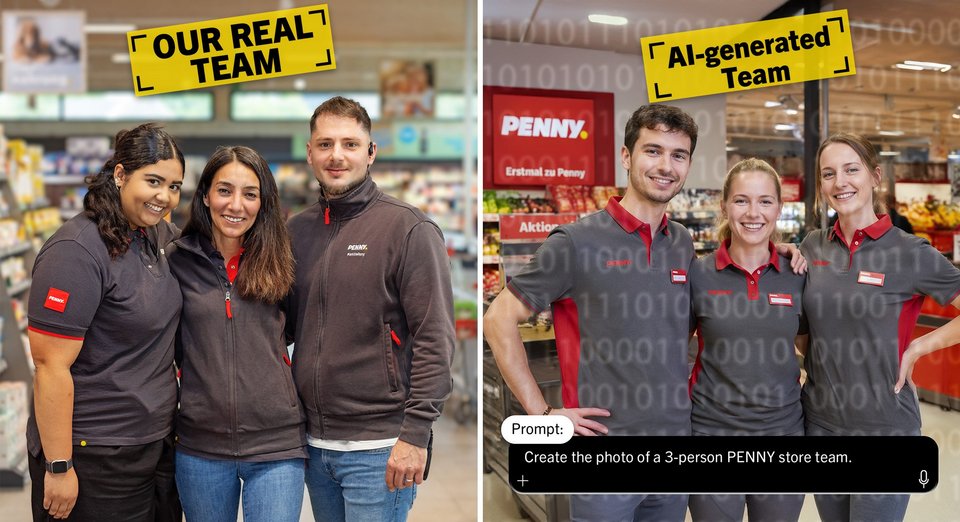

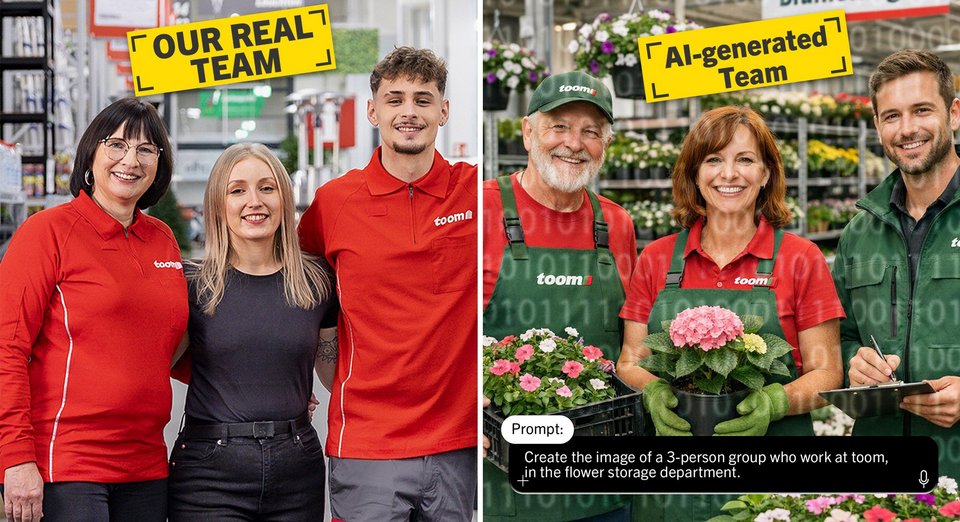
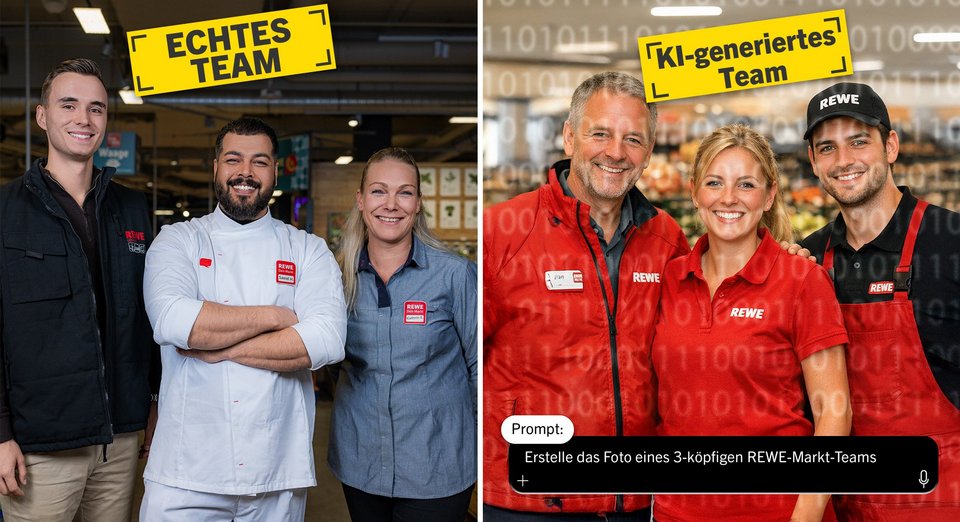
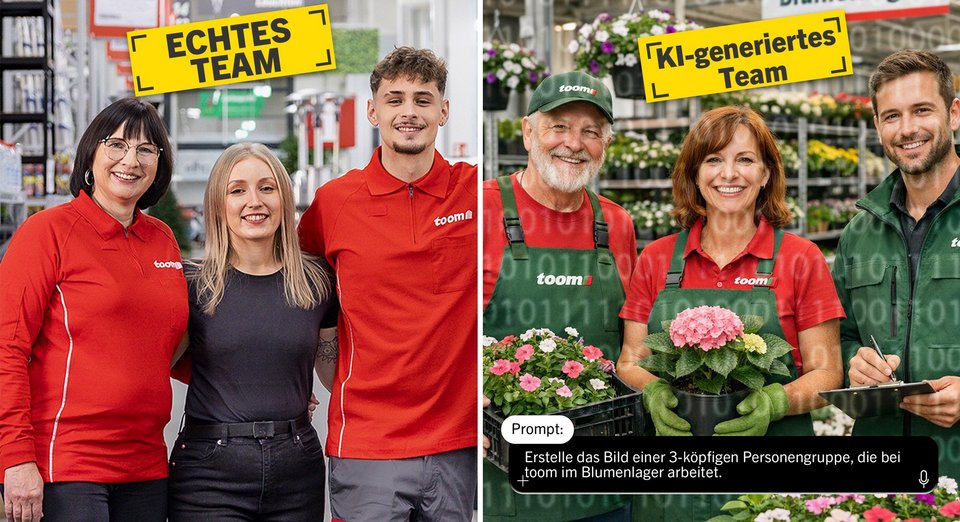
The good news is that each and every one of us can contribute to a more inclusive use of AI - with every single prompt. Natalia Schwarz shows five concrete approaches on how you can make your AI use more conscious and inclusive.
 1) Define role and perspective
If you prompt without a role, you give the AI the power of interpretation and quickly end up with distorted results. If the prompt specifies the professional perspective from which the text is created, for example as an HR expert focussing on diversity, the AI delivers significantly more differentiated content in which topics such as equal opportunities or structural hurdles are more likely to be taken into account.
 2) Explicitly name the target group
Furthermore, a good prompt should clearly specify the target audience – for example, a diverse workforce including part-time staff, people with disabilities or those from different cultural backgrounds. If the prompt fails to mention certain groups of people, they are often missing from the AI output.
 3) Change of perspective as a cross-check
If the AI generates the same content from a different professional or socio-cultural background, the results are often completely different. Instead of specifying the role of an HR expert, for example, the prompt can ask to generate the same content from the perspective of a young trainee with a migration background who has just joined the company. By deliberately incorporating different roles and perspectives, blind spots become recognisable and the user's own way of thinking can be questioned. Users can also have content generated specifically from different target group perspectives in order to gain new points of view.
 4) Incorporate a bias check
To circumvent AI bias, users can ask the AI to check its results for hidden assumptions. So you can ask directly: Which groups of people are implicitly favoured or excluded? Are stereotypes being perpetuated?
 5) Actively demand visual diversity
The prompt should also specifically counteract AI bias when generating images. The bias is most visible and easiest to correct in images in particular. For example, the prompt can specifically define that the image should depict a diverse team with different genders, age groups and cultural backgrounds.
Natalia Schwarz emphasises: "AI does not deliver ready-made solutions. Good results are achieved through dialogue - through questions, clarifications and conscious decisions." The dialogue between humans and AI therefore remains crucial for the quality of the results.


Both German and English comments appear here.
Super wertvolle Information, gerne mehr davon.
Ich hätte jetzt auch gerne noch die "korrigierten" Bilder gesehen - mit den angepassten Prompts.
Mich hätten jetzt nochmal andere, genauere, angepasstere Prompts und deren visuelle Ergebnisse im Überblick und im Vergleich interessiert, nachdem ich den Artikel gelesen habe.
So oder so: Mehr von solchen Best Practices mit konkreten Beispielen aus der Praxis!
Liest sich gut und bringt mich weiter.