

The (working) world is changing - and we are changing with it. Whether AI, crises or vacancies: REWE Group sees today's challenges as opportunities for tomorrow and is responding by continuously developing collaboration and leadership with the Step up corporate culture initiative. Four opinions on the occasion of three years of Step up.
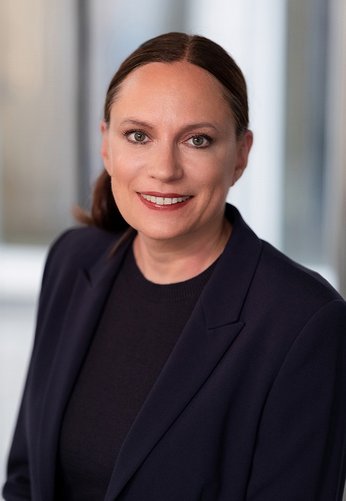 Daniela Büchel, Chief Human Resources Officer
Chief Human Resources Officer Daniela Büchel explains why she sees corporate culture as a competitive factor and why Step up is intended as a joint, long-term approach.
Daniela Büchel, Chief Human Resources Officer
Chief Human Resources Officer Daniela Büchel explains why she sees corporate culture as a competitive factor and why Step up is intended as a joint, long-term approach.
one: Daniela, three years after the launch of Step up, was it the right time to launch a cultural initiative throughout REWE Group?
Daniela Büchel: The timing couldn't have been better. We launched Step up to keep REWE Group fit for the future - in the midst of a time of profound change, in which the ability to change and innovate is becoming a competitive factor for a company. This is precisely why it was so important to create a framework that provides orientation. I was particularly motivated by all the feedback from the organisation. When Step up gives people in our organisation the confidence to talk to each other more openly, to become more courageous and to take responsibility more naturally - then I feel that we are not talking about concepts, but initiating real change. Focussing on strengths, personal responsibility and dealing constructively with mistakes - these are important cultural building blocks for our future viability. And it confirms to me time and time again that our togetherness will carry REWE Group through challenging times.
one: What motivates you personally to change REWE Group's corporate culture?
Daniela Büchel: I believe in the power of corporate culture. I am deeply convinced that culture is an important value and a real competitive advantage. That's why I'm happy about every example from everyday life in which Step up becomes visible - be it in a team meeting, in a dialogue with senior managers or in moments when people courageously try something new. That motivates me. At the same time, I expect myself not only to represent Step up, but to live it - to be a role model as a Management Board member and to continue to develop our culture together.
one: What do you want for and from Step up?
Daniela Büchel: Even though Step up has already achieved a lot, I still see areas where we can increase its impact. This includes making Step up an even more natural part of everyday life - in decisions, in our meeting culture, in the way we work together. I would also like to see us utilise our creative freedom even more courageously and give feedback even more consistently, even if it is sometimes unpleasant. Another point that is important to me is that we need more movement within the company - in terms of development, internal mobility and a genuine willingness to change. Courage is also required here. This will become a core competency in the coming years.
For me, Step up is not a project that will be completed at some point, but a long-term path that we are all travelling together in this company.
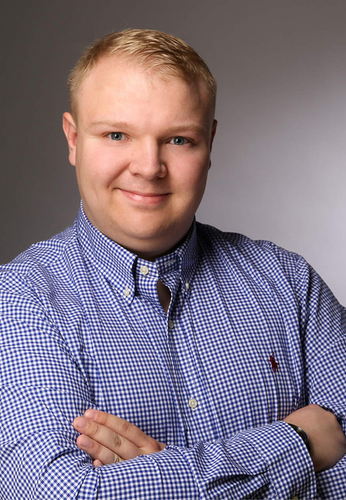 Philipp Kullmann | Photo ©private
Philipp Kullmann began his career at the company in 2016 with an apprenticeship as a wholesale and export merchant at the Cologne headquarters. After holding various positions, including in own-brand purchasing and at PENNY, the Thuringia native is responsible for wine, sparkling wine and spirits as a category buyer at REWE. he completed the Young Professional Programme in 2018 and is currently taking part in the Senior Excellence Programme. In addition to his job, Kullmann completed three part-time degree programmes on his own initiative, including one in business law.
Philipp Kullmann | Photo ©private
Philipp Kullmann began his career at the company in 2016 with an apprenticeship as a wholesale and export merchant at the Cologne headquarters. After holding various positions, including in own-brand purchasing and at PENNY, the Thuringia native is responsible for wine, sparkling wine and spirits as a category buyer at REWE. he completed the Young Professional Programme in 2018 and is currently taking part in the Senior Excellence Programme. In addition to his job, Kullmann completed three part-time degree programmes on his own initiative, including one in business law.
Philipp Kullmann: "Since my apprenticeship almost ten years ago, I have worked in various positions at REWE Group. I am currently preparing for management level 3 with the Senior Excellence Programme. My participation in the programme was a direct result of my Steps interview.
Compared to the previous KNP interview, I find Steps to be much more target-orientated. Instead of ticking off whether someone "meets the requirements", there is now room for free text and dialogue. As a result, I am more aware of my own strengths and weaknesses, and my senior managers are certainly also more aware of them. This makes areas for development more clearly visible and you can derive specific measures - for example via the training catalogue if you realise that you want to improve your public speaking skills, for example. The process is more targeted, more concrete and more practice-orientated than before. I find it much more appreciative.
I see potential for improvement in the GO! talent pool and the newsletter, which is supposed to provide me with vacancies tailored to my needs every fortnight. Many of the jobs suggested don't match my qualifications or areas of expertise. I smiled when I was recently offered the job of "food stylist". However, this often seems too broad for a pre-selection. Sometimes it would be more helpful to be informed that there are currently no suitable offers than this broad preselection.
What I find positive, however, is that the initiative for further development can now come more from both sides. While a lot of things used to come from senior managers at KNP, I can now play a much more active role in shaping my career path.
And I notice a more open and constructive feedback culture in the company overall. Tools such as 360-degree feedback, joint roadmaps and Feedback Me help to get people talking. You can tell that people have become even more important in our company. People take more time."
Step up was launched three years ago to further develop cooperation and leadership within REWE Group in the face of digitalisation, a shortage of skilled workers and constant change. The initiative is aimed at all employees and senior managers and consciously sees corporate culture as a competitive factor. The focus is on three behaviours: a focus on individual strengths, openness to feedback and the courage to try out new things and learn from experience. Step up is anchored by various programmes and formats such as STEPs talks, lead-up formats for senior managers, GO! for internal development and mobility as well as feedback and impulse sessions for everyday working life.
You can find everything about Step up here:
https://risnet.sharepoint.com/sites/REWEGroupStepupPortal/SitePages/Homepage.aspx
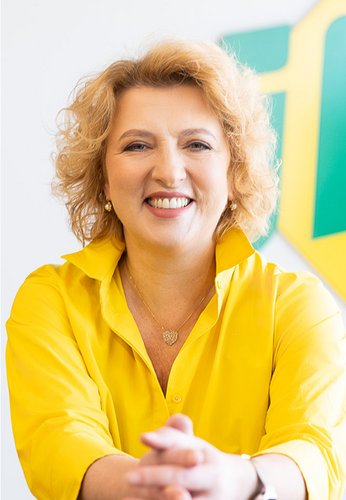 Nijole Kvietkauskaite, CEO of IKI Lithuania since 2020
Step up is also shaping the corporate culture of national companies internationally, as the example of IKI Lithuania shows. CEO Nijole Kvietkauskaite describes how Step up is changing everyday working life at IKI: Teams work in a strength-orientated way, feedback is actively practised - and successes become visible.
Nijole Kvietkauskaite, CEO of IKI Lithuania since 2020
Step up is also shaping the corporate culture of national companies internationally, as the example of IKI Lithuania shows. CEO Nijole Kvietkauskaite describes how Step up is changing everyday working life at IKI: Teams work in a strength-orientated way, feedback is actively practised - and successes become visible.
one: Nijole, how has Step up arrived at IKI in Lithuania?
Nijole Kvietkauskaite: Right from the start, we made sure to recognise and utilise the strengths of each individual. This has changed the way we talk about performance, development and co-operation. Step up is not a temporary project, but an integral part of our corporate culture. The topic of strengths is firmly anchored in the onboarding of new employees, in one-to-one meetings, in STEP discussions and in talent programmes. Over 400 employees in the head offices and more than 95 per cent of store managers are already taking part. Short surveys show that this approach is really being utilised in everyday working life.
one: Are the changes noticeable and measurable?
Nijole Kvietkauskaite: As a first step, we have specifically built up internal expertise. More than 15 internal trainers made it possible to implement the programme quickly, cost-effectively and uniformly throughout the entire company. This enabled us to significantly increase our credibility.
Secondly, commitment is high. Feedback on the workshops averages 4.5 out of 5, and over 20,000 strength-based acknowledgements have been shared via the MELP tool, a platform for positive feedback and dialogue among employees. This shows that colleagues are actively living the culture
Thirdly, we measure real impact. 84 per cent of employees know their strengths and 78 per cent apply them in their day-to-day work. At the same time, only six out of ten feel that their strengths are fully valued - this gives us a clear focus for the next phase.
one: Where else do you see potential for improvement at IKI?
Nijole Kvietkauskaite: We want to delve even deeper into the topic of feedback. Firstly, we used Erin Meyer's culture model ("Culture Map") to look at how the way criticism is given is linked to the respective culture. The next step is - with the help of various modules - the practical ability to give and accept feedback clearly, respectfully and constructively.
We anchor feedback rituals via the IKI Feedback Compass, integrate feedback into leadership competences and. Looking ahead, I also see great potential in developing resilience in a targeted way - to help people stay focussed, learn and develop even in challenging times. We are introducing fixed feedback formats via the IKI Feedback Compass, using feedback as an integral part of leadership and involving top managers in external feedback programmes. For the future, it is important to us to strengthen the resilience of our employees - so that they can stay focussed, learn and develop even in challenging times.
one: Does Step up also have an impact on international cooperation within REWE Group?
Nijole Kvietkauskaite: In my experience, international cooperation depends less on structures than on attitude. Step up creates a common language around strengths, feedback and learning, which makes collaboration across countries more open and effective. I experience more honest conversations, better listening and a greater willingness to learn from each other. That creates trust. For me, this is one of the most valuable outcomes of Step up: it helps us to feel like a group united by common values - even across different countries and cultures.
Nijole Kvietkauskaite, CEO of IKI Lithuania since 2020
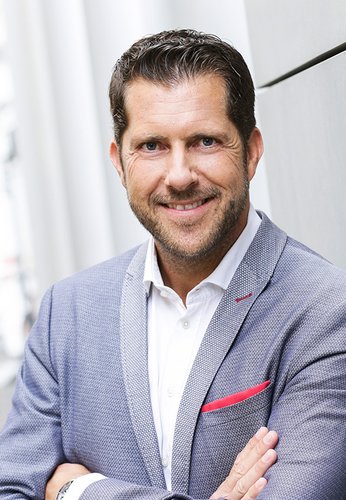 Stephan Koof, Managing Director Real Estate at REWE Group
Using specific examples, Stephan Koof outlines the impetus Step up has given him and the senior managers in his division.
Stephan Koof, Managing Director Real Estate at REWE Group
Using specific examples, Stephan Koof outlines the impetus Step up has given him and the senior managers in his division.
Stephan Koof: "Our senior managers who took part in Lead up were particularly enthusiastic about the interdisciplinary exchange. This offered valuable suggestions, support and an intensive exchange on dealing with leadership and with each other, and therefore also on processes and communication, which could be profitably transferred and implemented in their own work and that of the respective department. My senior managers then worked openly, creatively and constructively on various optimisation topics in a workshop format ("transfer workshop"), which are now being fed back into the individual teams.
We will continue to regularly analyse the impulses and results that emerged from participating in the step-up formats in the future. The focus will be on making work easier and cutting costs.
You may well ask what this has to do with Step up specifically. Because yes, we have done this before. But the Step up programme has obviously triggered thought processes that were not there before or went in completely different directions.
Stephan Koof, Managing Directors Real Estate