
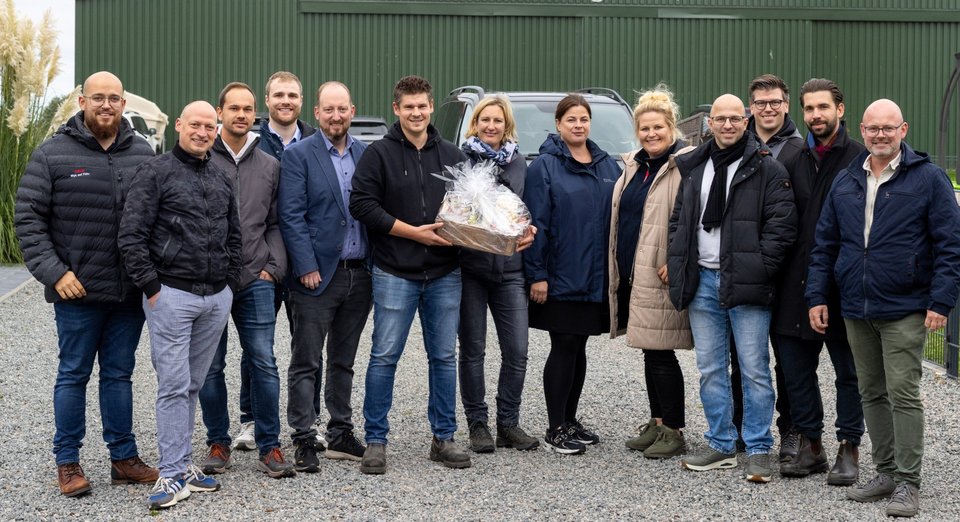
A strong domestic agricultural sector is a vital foundation for the food supply of tomorrow. To play an active role in shaping the transition towards a sustainable agricultural and food sector, the REWE Group relies on close collaboration with its agricultural partners and gives REWE Group staff the opportunity to experience their day-to-day work first-hand. Read more information and hear from the people involved here.
A key component of this collaboration is the Agricultural Academy. Since 2023, this Germany-wide programme run by the Centre of Excellence for Agriculture has enabled staff from REWE, PENNY and the REWE Group to visit the farms of the more than 33,000 local producers with whom the REWE Group works.
The Centre of Excellence for Agriculture brings together the REWE Group’s agricultural expertise and acts as the central point of contact for agricultural matters. It contributes agricultural expertise to strategic and operational business decisions
and strengthens dialogue with producers, partners from the agri-food sector, policymakers and other stakeholders along the agricultural value chain. Furthermore, the Centre of Excellence monitors and assesses developments in agricultural policy and society, promotes company-wide knowledge transfer and, together with internal and external partners, develops practical solutions for sustainable agriculture. In this way, it helps to further develop cooperation along the supply chain with a focus on sustainability.
These visits provide direct insights into agricultural practice and foster dialogue between the retail sector and the agricultural sector. At the same time, they convey a realistic picture of the current challenges and developments in the domestic agricultural and food sector. These range from the impacts of climate change and protracted approval procedures for the animal-welfare-compliant conversion of livestock housing, through to the preservation of family-run farms, and the opportunities and challenges posed by digitalisation and the use of artificial intelligence.
The programme is divided into six different modules, each aimed at a specific target group: REWE trainees, junior business administrators and specialist staff in the stores, PENNY employees, colleagues at the Central locations, and the management team of the Centre of Excellence for Agriculture. Depending on the target group, the formats are precisely tailored to their respective needs and range from regional programmes to cross-regional excursions.
For example, trainees can visit farmers as part of a seminar module, whilst young business trainees are given the opportunity twice a year to get to know farms across different regions. Another particular highlight is the ‘Farmer for a Day’ initiative: here, staff from the Central locations spend a day working on a farm, thereby experiencing everyday farming life first-hand.
Regardless of the format, the focus of these farm visits is always on practical experience. Participants spend at least one day on a farm, where they experience the diversity of modern agriculture. In the process, they gain insights into livestock farming, vegetable production, fruit growing, arable farming and farm management, whilst actively participating in day-to-day farm operations. At the same time, they see how modern technologies – from digital feeding systems and camera technology to AI applications – are already supporting work on many farms today.
 Andreas Kronschnabel, trainee business administrator, REWE Süd
I’ve always been a fan of working with local producers. The Agrar-Akademie has made me even more keen to simply approach people. I’ve gained confidence in dealing with farmers and now feel able to speak to them directly. In addition, the Agricultural Academy provides a better basic understanding of the challenges and changes facing the farming sector.
Andreas Kronschnabel, trainee business administrator, REWE Süd
I’ve always been a fan of working with local producers. The Agrar-Akademie has made me even more keen to simply approach people. I’ve gained confidence in dealing with farmers and now feel able to speak to them directly. In addition, the Agricultural Academy provides a better basic understanding of the challenges and changes facing the farming sector.
On-site visits offer a valuable change of perspective. They demonstrate not only how food is produced, but also the achievements and challenges associated with the day-to-day work of agricultural businesses.
The insights gained from these visits have an impact far beyond the visit itself. Whether in customer advisory services, on the shop floor, in administration or in management roles: these practical experiences are incorporated into day-to-day work, shared within the respective teams and thus foster an even better understanding of the interconnections along the value chain. This further reinforces awareness of just how crucial a partnership-based and mutually respectful collaboration between the agricultural sector and the retail sector is.
 Benjamin Wölk, Head of Purchasing at PENNY Germany
For me, insights like these are particularly valuable because they help me to get a true picture of the situation and understand the passion behind it. Only then does it become clear just how important it is to preserve family-run farms, to value the human labour behind them and to ensure the welfare of the animals. This overall picture makes it clear to me why working with farmers is so important.
Benjamin Wölk, Head of Purchasing at PENNY Germany
For me, insights like these are particularly valuable because they help me to get a true picture of the situation and understand the passion behind it. Only then does it become clear just how important it is to preserve family-run farms, to value the human labour behind them and to ensure the welfare of the animals. This overall picture makes it clear to me why working with farmers is so important.
 Tiia Biller: Work-study student in logistics, Northern Region
Through the Agricultural Academy, I was able to gain fascinating insights into farming, as the farmers spoke openly about themselves and their daily lives on the farm. It was particularly interesting to experience poultry farming at first hand and to learn more about topics such as egg sizes or the differences between organic and free-range farming. Through these encounters, I’ve developed a better understanding of their work and have come to appreciate food even more.
Tiia Biller: Work-study student in logistics, Northern Region
Through the Agricultural Academy, I was able to gain fascinating insights into farming, as the farmers spoke openly about themselves and their daily lives on the farm. It was particularly interesting to experience poultry farming at first hand and to learn more about topics such as egg sizes or the differences between organic and free-range farming. Through these encounters, I’ve developed a better understanding of their work and have come to appreciate food even more.
The positive feedback received in recent years shows that the Agricultural Academy has generated a great deal of interest: some 15,000 colleagues have already visited farms as part of the Agricultural Academy programme.
 Dr Carolin Weyers, Head of the Centre of Excellence for Agriculture
As an employee with a background in agriculture, I have been struck for several years now by just how far removed many people have become from farming. When I asked colleagues whether they had ever visited a farm, the answer was far too often: ‘No.’ That is precisely why we set up the Agricultural Academy.
Dr Carolin Weyers, Head of the Centre of Excellence for Agriculture
As an employee with a background in agriculture, I have been struck for several years now by just how far removed many people have become from farming. When I asked colleagues whether they had ever visited a farm, the answer was far too often: ‘No.’ That is precisely why we set up the Agricultural Academy.
We are therefore all the more delighted that participants speak with such enthusiasm about their experiences and are also encouraging others to take part. That is precisely our aim: to build bridges between agriculture and the retail sector and to strengthen dialogue with a focus on sustainability.
This positive trend encourages both the Centre of Excellence for Agriculture and the REWE Group to continue developing the programme. As a result, visits to farms are set to become an integral part of the training programme in future.
After all, the experience of recent years clearly shows that those who experience farming first-hand not only gain valuable knowledge about where our food comes from, but also develop a deeper understanding of the people whose daily work lays the foundations for our food supply.
 Ümit Metiner: Businessman, REWE Süd and organiser of the Agricultural Academy in the Southern Region
Taking a look behind the scenes has shown me just how much dedication, passion and investment go into regional produce. This fosters a better understanding and a more sensitive approach to pricing. I’m also more conscious of how regional products are positioned on the market. Regional producers and farmers are what make REWE what it is. Customers buy regional products despite higher prices because their origin and production are transparent.
Ümit Metiner: Businessman, REWE Süd and organiser of the Agricultural Academy in the Southern Region
Taking a look behind the scenes has shown me just how much dedication, passion and investment go into regional produce. This fosters a better understanding and a more sensitive approach to pricing. I’m also more conscious of how regional products are positioned on the market. Regional producers and farmers are what make REWE what it is. Customers buy regional products despite higher prices because their origin and production are transparent.